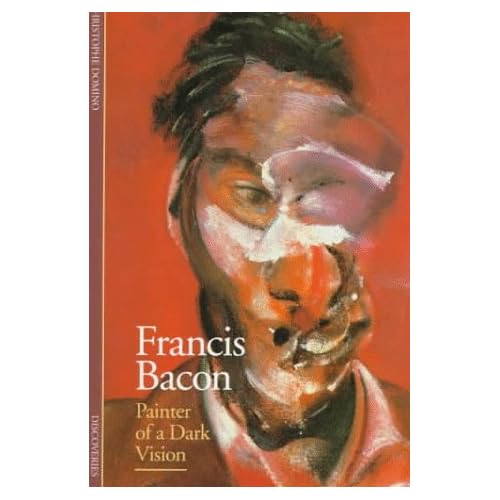
Francis Bacon: Painter of a Dark Vision (Discoveries)
Category: Books,Biographies & Memoirs,Arts & Literature
Francis Bacon: Painter of a Dark Vision (Discoveries) Details
Language Notes Text: English (translation) Original Language: French Read more


Reviews
This is a small book that is able to illustrate a large number of the works of Francis Bacon, contains multitudes of photographs of Bacon and his social network as well as the photographic source materials used in his painting, has insightful essays on the nature of the work and other source materials, and does a good job of integrating biographical material into the essays and linking the biographical with the paintings. This is a small book at a reasonable price that covers a considerable amount of territory. It is a bargain and I recommend it strongly.Bacon in a quotation from Daniel Farsom's 1993 book on Bacon says that he would like his pictures to look as if `a human being had passed between them, like a snail, leaving a trail of the human presence and memory of the past events as the snail leaves its slime.' I was struck by how this concise quotation summarizes both the underlying existential philosophy of the artist and also summarizes his artistic approach to the human figure.Bacon, like so many artists in the 20th century, was influenced by Picasso. But there is a certain existential despair and thus horror that Bacon is able to convey that is unnerving. Picasso is able to capture the pain of warfare or screaming women, but the graphic qualities remain so strong that the drawing outweighs the terror. Bacon, drawing on the paintings of Rembrandt and Soutine of meat, developed an ambiguous style that conveys indistinct terror, subjective horror, and an image that is difficult to recall once the eye looks away and yet an image that connects with the human fears of life's challenge for meaning and looming death. It is actually Bacon's strength that he conveys not just death as a terror, but also life, for life in the face of psychological pain and the complete struggle to create meaning out of meaninglessness is indeed a terror. In the mind's eye, we can create in our memory the image of Picasso's screaming mortally wounded horse in Guernica, but the mind's eye can rarely recall the ephemeral horror in Bacon's images of the human face.The use of the terms `horror, terror, and nightmare' must be carefully used when describing Bacon's work. The paintings do not capture the horror of a monster terrorizing a campground of school girls, but rather captures the horror of being caught inside a human body, full of human sensations and thoughts and memories, moving from a fragile existence to an unimaginable non-existence. The paintings are not about burglars and murderers but about the everyday experience of the flesh weakening and gradually becoming the clay left when we take our final breath.Bacon's lover George Dyer, is shown in photographs and painted images. If there is a weakness to this small book, it is that the relationship between Bacon and Dyer might have been explored in more detail, especially as it related to the paintings. George Dyer was an under-employed burglar who accidentally falls through Bacon's skylight and then is invited by Bacon to spend the night. This story is too amazing not to be true. A dark angel falls from heaven into the studio-home of an artist and becomes the masculine, earthy muse that inspired many of Bacon's best works. There is a quality to the masculine presence of the man with whom Bacon lived his life and the ephemeral quality of that man captured on the canvas. When in close proximity with another human, particularly one with whom we are intimately involved, they are both static and yet fleeting, they are physically real and yet constantly disappearing into a vaguely remembered past. The experience of being in relationship and proximity to the other person has resonance to the experience of creating that person, the image of that person, on the canvas. Both are fragile specks of time absorbed by moving sensation and shifting perception. The painting `Triptych May June 1973' is included in this book and is one of the most fascinating paintings of the 20th century for in this painting Bacon captures the final hours in the life of George Dyer as he vomits and then defecates and they dies sitting on the toilet. He honors his muse with this last rendering of the human struggle.Bacon's technique draws from both the Surrealists and the Abstract Expressionists since he uses chance, accident, automatic writing technique, and thrown, spattered and smeared paint as techniques. Like the Surrealists, the accidental drawing created by random chance may form the initial structure upon which he slaps and smears the paint to create the ambiguous vague ephemeral image.Bacon once remarked to critic David Sylvester, that he had never painted the smile. This is an interesting remark for the human smile has many characteristics in common with a grimace of pain and the eyes help distinguish between the smile and the grimace. Also, whereas the grimace may be held for a few minutes the true spontaneous smile is often fleeting and short. Thus the static image on the canvas is more akin to the grimace than to the fleeting nature of a smile. Leonardo Da Vinci masters the visual image in the Mona Lisa since he allows the smile to gradually emerge in the milliseconds before an amused smile would be fully evident. Bacon wisely avoided this territory.Domino makes the connection between Bacon and Umberto Boccioni in regard to depiction of movement in the static image. There are a few examples of Bacon making preliminary sketches, but Bacon's painting style would not lend itself to the preliminary sketch except in the capture of a general visual concept since chance and accident play such a significant role in the painting style of Bacon.This book is only 5 inches by 8 inches but there are ample illustrations and photographs. It is well written and organized. I recommend it.